01
Find the priority
We review the homepage and up to two priority public pages, looking at technical access, mobile use, content clarity and the path to an inquiry.
FREE WEBSITE AUDIT / A FOCUSED FIRST LOOK
Not sure whether you need a redesign or a few targeted fixes? Tell us what is not working. We review your public pages and send practical recommendations by email.
No budget field. No obligation to commission the work. Scope and delivery date confirmed by email.
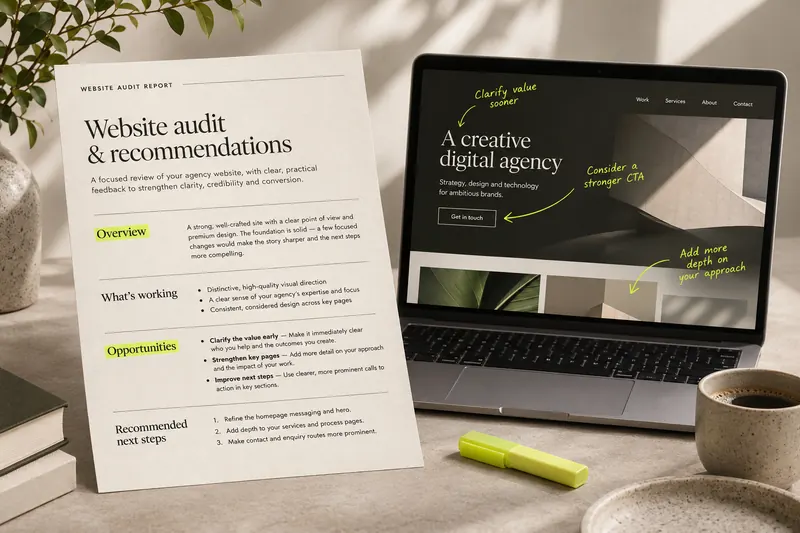
What you receive
01
We review the homepage and up to two priority public pages, looking at technical access, mobile use, content clarity and the path to an inquiry.
02
The written email summary explains the observation, why it matters and a recommended next step. It is a focused review, not an automated whole-site report.
03
We confirm scope and a delivery date by email. You can use the findings to plan your own work or discuss a separate implementation scope.
Your website. Your question.
Tell us about a real business problem: confusing service information, a difficult mobile journey or inquiries that do not match the work you offer. Specific context helps make the review useful.
Use the website you own or are authorized to discuss. Do not include passwords, payment details or private customer information.
We reply by email to agree the pages, scope and delivery date. The form does not create an instant report.
Read the findings, ask questions and choose the next step. Any implementation is agreed separately.
No fixed turnaround is promised. Private analytics, authenticated areas and specialist security testing are outside this free public-page review.
A sample finding might say: the mobile service page explains the offer, but the quote link sends readers back to the homepage. The next step is to link directly to the inquiry form and confirm the receipt message and routing after submitting a test.
To make the review more useful, name one kind of customer you want to reach and one task they should be able to complete. Share the public URL and any page you want us to prioritize.
Tell us which page matters most and the result you want it to support.
See what a separate optimization project can coverA realistic scope
A public-page review can identify visible problems and practical checks. It cannot authenticate private data, guarantee rankings or certify website security.
Inside the review
The starting point is a focused review of your public website and the business goal you describe. We look at the homepage and up to two priority pages, such as a service, product or inquiry page. That scope helps connect technical observations with the action you want visitors to take. A missing service explanation and a broken form are different problems, so the review identifies the evidence behind each recommendation. If you have a particular concern, include an example of the page or interaction where it happens. The request helps us determine which checks are relevant before we confirm the review scope.
Send your website address, business email, target market and the challenge you want to solve. Your request goes to the agency’s email inbox. We use those details to confirm that the public site is accessible, agree which pages to review and reply with the delivery date before beginning. Findings are shared by email as a written summary. The review uses available tools and a review of the public pages. It is a request-led service, so the form confirmation records your request and the follow-up email confirms the scope and schedule. A paid project is quoted separately if you ask for implementation.
We can inspect public page responses, titles, headings, canonical tags, indexing directives and the sitemap. These checks help identify whether a page is available to crawlers and whether internal links lead to the intended destinations. A useful observation names the URL, the behavior seen and the action to take. For example, a service page that is available only through a vague button may need a descriptive link from a related guide. Actual indexing, search queries and historical traffic need access to first-party reports. If those reports are unavailable, the written findings explain which conclusions can be drawn from public evidence.
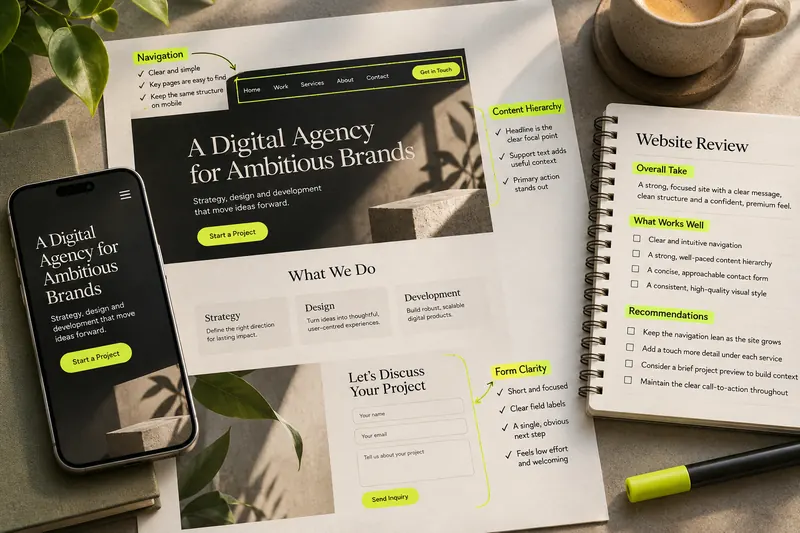
The review can use a lab report and a walkthrough on a narrow screen to identify issues worth investigating. Large images, late-loading fonts and scripts can affect what a visitor sees and when the page responds. We describe the URL and test context so a developer can repeat the check. A single performance run can vary with the device, connection and server response. When real-user data is available, it can add context, and the summary distinguishes it from a simulated test. We prioritize problems that affect reading, navigation or the main inquiry path so the next step is connected to a customer task.
We look at whether a visitor can understand the offer, identify the relevant service and find the next step. We review the visible form fields, labels, validation and confirmation where those can be inspected safely. The question is whether the page gives a suitable buyer enough information to act. A repeated customer question can reveal content that deserves an earlier position. We may recommend a clearer call to action, fewer unnecessary fields or a more relevant example near a quote request. Any real submission, purchase or account interaction requires your agreement and an appropriate testing arrangement.
The public review can note HTTPS availability, visible mixed-content issues and a limited set of response headers. Deeper security assessment requires a separately agreed scope and qualified testing. We do not request passwords through this form. A competitor comparison may be useful when you name one or when a relevant public result can be verified. That comparison can explain a difference in service coverage, page structure or the inquiry offer. It does not establish competitor traffic, sales or private analytics. If public evidence does not support a conclusion, the finding remains an open question for a follow-up discussion.
A finding should show the page, the observation and why the issue matters for the business goal. It should also describe a practical next step and how to check whether it worked. For example, a broken internal link needs the destination and a successful response check. A vague service introduction needs a clearer explanation of the audience, deliverables and next step. A performance issue needs a reproducible test and an assessment of which assets contribute. This lets you review the recommendation yourself, share it with your existing developer or request an implementation quote. Keep a copy of the findings and the date so later changes can be compared against the same baseline.
If the structure is useful and one part of the site is causing friction, website optimization may be the appropriate next step. If multiple layouts, content and navigation need to change together, website redesign can provide a coordinated release. A business launching its first site can compare a starter website with a focused landing page. A store may need closer attention to product discovery, variants and checkout. The review helps frame that choice. The budget ranges in the project inquiry form are a starting point for a discussion. A written proposal defines the pages, responsibilities, integrations and checks included in a paid project.
Enquiry sent
Thanks for sharing your project with us. We’ll reply to the business email address you provided.
Prefer a direct line?