Content & structure
Agree which pages to keep, rewrite or combine. Navigation and service descriptions should help a customer recognize the right offer without needing a guided tour.
WEBSITE REDESIGN / PLAN · REBUILD · RELAUNCH
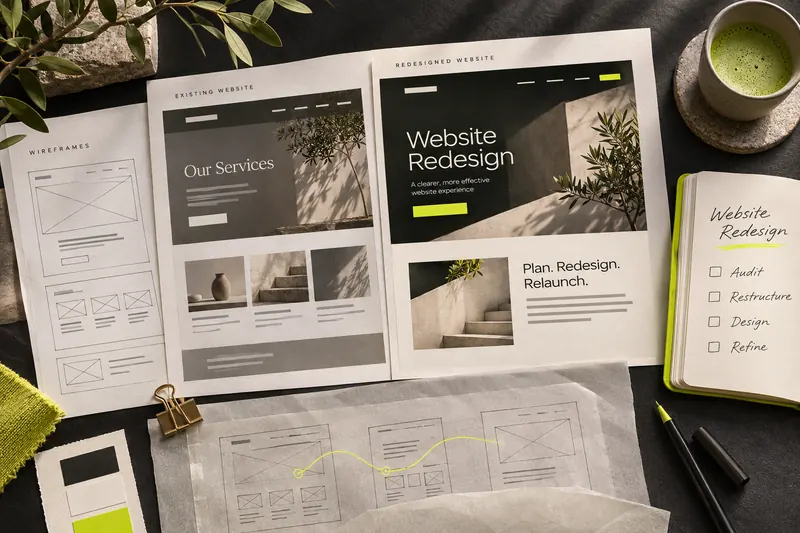
Your business has moved forward. Your website should explain where it is now. We redesign small-business and service-company websites around the questions customers ask, the pages worth keeping and the inquiries you want to receive.
Ask for a page list, the number of distinct layouts, who supplies copy and what happens to URLs that change. A homepage refresh and a platform migration are different scopes even when both are called a redesign.
If a consultant adds two services and has a contact form that works, start by fixing the navigation and service pages. If the platform prevents the team from editing content or maintaining redirects, include platform migration and handoff in the proposal.
Start with the pages buyers already rely on. List your current website, what you need to change, and any launch date you are working toward.
Use the redesign launch checklistThe scope
Agree which pages to keep, rewrite or combine. Navigation and service descriptions should help a customer recognize the right offer without needing a guided tour.
Turn the agreed structure into responsive page layouts. Review a representative service page and inquiry journey before extending the design across the site.
Document changed URLs, check redirects and confirm forms work on the public release. A visual refresh should come with a practical plan for the switch.
A considered process
The working detail
Use these questions to prepare a more useful brief and compare the work behind a proposal.
Walk through the website as someone who has just heard your business name. Can you tell which problems the company solves, find the service that fits, and understand what happens when you make contact? Repeat the exercise on a phone using the public site, without being signed into its content manager. If the main issue is an unclear headline or a hard-to-use form, isolate that work first. A rebuild becomes easier to justify when the navigation, templates and publishing process all prevent the same improvements. Document what works, too. A popular service page with plain styling may be doing its job better than a polished page that attracts no useful inquiries.
Build a spreadsheet with the current URL, page purpose, suggested action and owner. Pull URLs from your navigation, sitemap, analytics and search reports because each source may surface pages the others miss. Mark content you intend to keep, combine, rewrite or retire. Include PDFs and campaign pages when customers or partners still link to them. For each proposed merge, write down what information must survive and where a returning visitor should land. A single column for destination URL makes unresolved decisions obvious. If the business has multiple teams, agree who can approve changes to old content before anyone starts moving pages into the new platform.
Pick the two or three customer journeys that matter most. For a service firm that might be comparing engagements, checking fit and requesting a quote. Design a representative page for each journey before spending time on variations. Ask a reviewer to find a specific answer, such as whether you handle work in their industry or what details you need for a proposal. Watch where they look. This reveals whether your section order and labels are doing useful work. Carry decisions into reusable layouts so a later service page can inherit the same clarity without copying the original page’s copy or forcing every service into an identical story.
A redesign can use your current platform if it supports clean page layouts, ordinary content updates and the integrations you rely on. Ask whoever maintains the site to demonstrate editing a service page, changing a menu and recovering an earlier version. Record which steps require a developer. If you do move, identify what needs to transfer before comparing tools. That includes form notification settings, user roles, downloadable files and content that is stored outside the page editor. For any paid add-on, record who owns the subscription and who can renew it. This makes the handover practical and reduces the risk that routine edits become a separate project.
Use a permanent redirect where a URL changes and there is a relevant replacement. Test a sample drawn from pages people use, then test the whole agreed redirect list before release. A redirect that arrives at an unrelated page may technically work but can still disappoint visitors. Check internal links, canonicals and sitemap entries so they point directly to the new preferred URLs. If you combine a blog article into a guide, make sure the guide actually covers the questions that brought people to the older article. After release, use Search Console and server responses to watch for omissions, especially on old URLs that continue to receive visits.
Choose one set of pages that has a clear purpose and can ship together. A practical phase might update the homepage, a priority service page and the inquiry path while keeping the existing platform and brand. Define what counts as approved content and how many distinct layouts need to be designed. Reuse sections for later pages when they support the same customer decision. Set aside time to test the release, even when the design scope is small. If a proposal includes migration, copywriting or ongoing support, ask for those items to be shown separately. This gives you a way to reduce scope without accidentally removing the work that protects the site at launch.
Share the current site, the main reason you want a change and the actions you want customers to take. Mention the pages or tools you must keep, and whether anyone on your team can write and approve new content. A useful example is a specific inquiry that you want more often, such as an owner requesting a multi-page redesign with an existing service list. Describe your budget range and any date that affects the work. A launch tied to a campaign has different constraints from a redesign that can release in phases. When the brief identifies those constraints early, the proposal can describe a realistic first release and what can wait.
Before the public switch, agree who can make hosting changes, who checks forms and who can restore the previous site if a serious issue appears. Have one person test from a phone and another review the old URLs, navigation and sitemap. Keep a short record of the issues that were fixed and any decisions deferred until later. Ask the team responsible for the website to edit a small piece of content themselves before signoff. Their ability to find the right page, make the change and see it appear is part of the acceptance check. Schedule an early review so changes in traffic or inquiry patterns are investigated with context.
Questions & answers
Yes, when the current platform and layouts support the changes you need. Send the URL and the main problem. A focused refresh may be a better first project than a complete rebuild.
No provider can promise unchanged rankings. Keep useful URLs and content, map necessary redirects and monitor Search Console after launch. We discuss the migration work in the scope rather than treating it as an automatic side effect of design.
Share the current URL, priority pages, content responsibilities and any deadline. We can then separate essential work from a later phase and identify integrations or platform changes that affect the quote.
Enquiry sent
Thanks for sharing your project with us. We’ll reply to the business email address you provided.
Prefer a direct line?